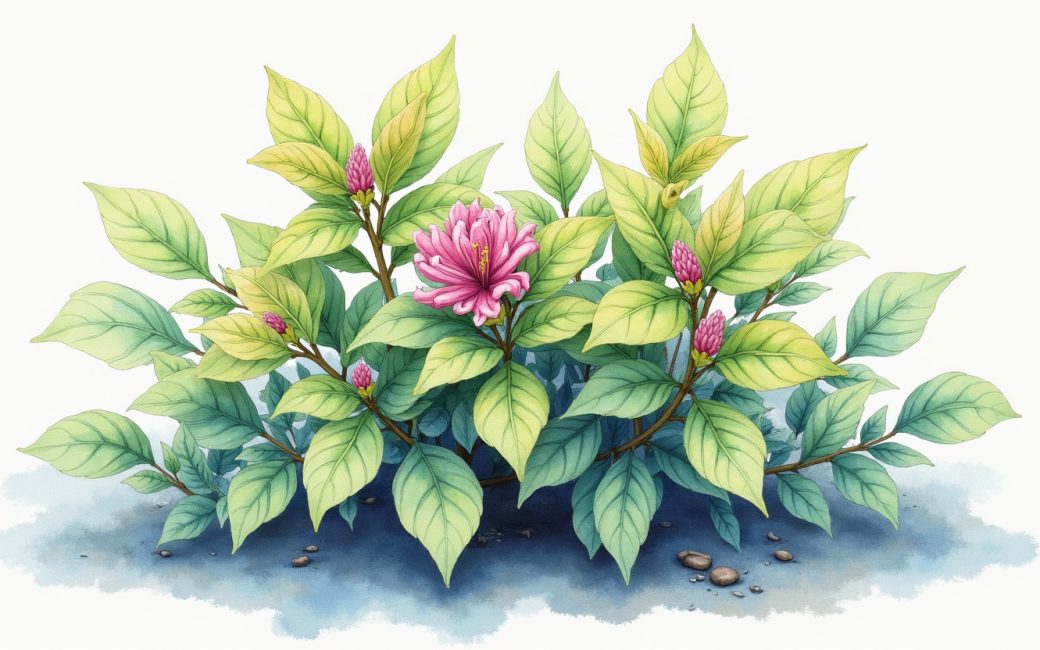
Soil pH drifts above the azalea's preferred acid range, or nutrients simply run short
Yellow leaves with green veins and weak flowering usually mean one of two things: the soil has drifted out of the acid range azaleas need, or the plant is short on nitrogen. Azaleas take up iron and manganese poorly once soil pH climbs too high for their preference, and that failure shows up as interveinal chlorosis on new growth even when the soil has plenty of those nutrients present — the roots just can't access them at the wrong pH.
Before buying any product, confirm which problem is actually happening. A soil test is the only way to tell a pH problem from a hunger problem, since both produce pale foliage and sparse bloom but call for opposite fixes — one needs sulfur to lower pH, the other needs nitrogen. Guessing wastes a season, because correcting nitrogen won't fix a pH-locked plant, and acidifying soil that's already in range won't fix a starved one.
Once a test confirms the plant needs feeding, an acid-forming azalea and camellia fertilizer applied in early spring, right after bloom, is the standard approach. Clemson HGIC recommends feeding azaleas after flowering with an acid-forming fertilizer formulated for azaleas and other acid-loving plants, since these formulations supply nitrogen in a form that also helps hold soil pH down rather than pushing it upward over repeated seasons. Water it in thoroughly so the nutrients move into the root zone instead of sitting on top of the mulch.
A balanced 10-10-10 is sometimes used on azaleas and will supply nitrogen, phosphorus and potassium, but it carries none of the acidifying compounds that keep pH from creeping upward the way a dedicated azalea-camellia formula does — on soil that's already borderline, repeated use of a plain balanced fertilizer can work against the plant over several seasons even while the season's growth looks fine. If a soil test shows pH is already well within range, this difference matters less; if pH is drifting high, the acid-forming formula is the safer long-term choice.
Coffee grounds are often suggested as a folk acidifier, but fresh grounds are only mildly acidic and their effect on established bed pH is minor and slow compared to actual soil sulfur amendments — they're better thought of as a small organic matter addition than a pH fix. Epsom salt supplies magnesium and sulfur, and it only helps if a soil test actually shows a magnesium deficiency; applying it as a routine tonic without that evidence does nothing for bloom and can add unnecessary salts to a shallow root zone.
Fertilizer is applied in late summer or autumn
Late-season feeding is the most common reason azaleas suffer cold damage that looks like winter kill but isn't. Nitrogen applied after mid-to-late summer pushes a flush of soft new growth that hasn't had time to harden off before the first hard frost, and that tender growth is what gets damaged by cold — the established wood is usually fine.
The fix is timing, not toughness: stop feeding at the end of the plant's active growing season and let new shoots harden naturally going into fall. Hawk's Landscape covers this cutoff as part of general winter care, tying the end of feeding to the approach of dormancy rather than a fixed calendar date. For once-blooming azaleas, that generally means one application shortly after the spring bloom and nothing later in the year. Repeat-blooming types marketed as Encore azaleas flower more than once per season and are fed on a schedule tied to those bloom cycles rather than a single spring date — Encore Azalea's own guidance describes feeding across the growing season but still cuts off well before fall so growth can harden before cold weather arrives.
Newly planted azaleas are a separate case. A shrub still establishing its root system in its first season is generally better served by consistent watering than by a full feeding program, since heavy fertilizer at planting can outpace what the undeveloped root system can use and risks burn on roots that haven't spread into surrounding soil yet. Waiting until the plant has been in the ground through one growing season before starting a regular feeding schedule is the more conservative approach.
Azaleas root shallowly and fibrously near the surface
Azalea roots sit close to the surface in a dense, fibrous mat rather than reaching deep, and that shallow structure is exactly why concentrated fertilizer causes damage fast. Granules piled against the stem or applied at a heavier rate than the plant can absorb will scorch those surface roots, and the visible result is scorched or browned leaf margins and general decline — a symptom easy to mistake for disease or drought stress rather than fertilizer burn.
The correction is in the method, not just the ingredient:
- Use a slow-release, acid-forming formula rather than a fast-release granular at full strength on a shallow-rooted shrub.
- Spread it evenly across the root zone out to the drip line, not in a pile at the base of the stem.
- Water thoroughly after application to move nutrients down to the roots and dilute any concentration at the soil surface.
- Keep two to three inches of mulch in place over the root zone, pulled back slightly from the stem itself, since mulch buffers both moisture swings and fertilizer concentration.
Plants by Mail advises keeping fertilizer off the foliage and away from direct stem contact, then watering immediately to carry nutrients into the root zone rather than letting them sit on the surface.
Growing season sets the outer limit on when feeding does any good
Fertilizer only helps an azalea during the window when it's actively growing and able to use the nutrients — outside that window, applied nitrogen either leaches away, sits unused, or forces growth the plant can't support going into dormancy. That's why every timing question above resolves to the same principle: feed after bloom while the shrub is pushing new growth, and stop well before that growth needs to harden off for winter.
Check a soil test before applying anything this season, so the fertilizer answers a confirmed problem instead of a guess.