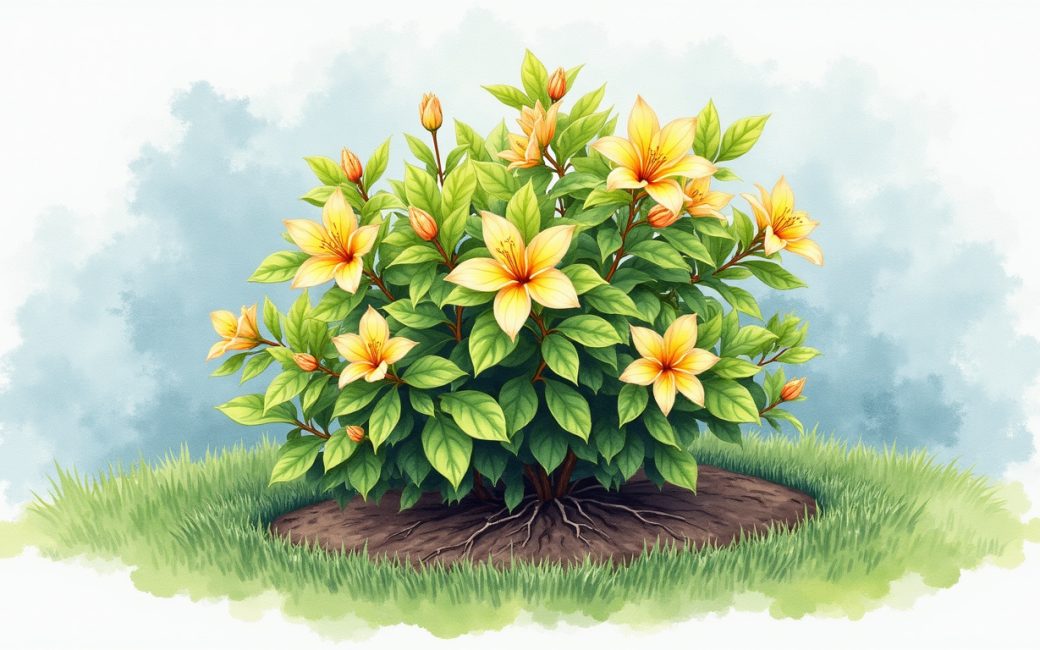
Native soil is alkaline (high pH)
Yellow leaves with green veins on an azalea planted near a limed lawn are almost always a pH problem, not a nutrient deficiency in the soil. Lime raises soil pH, and lime applied to a lawn migrates into adjacent beds through runoff and soil contact, pushing azalea roots into territory they cannot use.
Azaleas and rhododendrons are ericaceous plants that need a distinctly acidic root zone, generally cited around pH 4.5 to 6.0, to take up nutrients properly — Oregon State University Extension gives the acidification targets and methods for this plant group. Once soil pH climbs much above that range, iron becomes chemically locked in the soil — present, but not soluble enough for roots to absorb, a process one soil-pH guide walks through in detail for exactly this "unhappy azalea" scenario in limed or alkaline gardens (Spotts Garden). The visible result is interveinal chlorosis: leaves turn pale yellow while the veins stay green, new growth is stunted, and flowering drops off even though the plant isn't obviously diseased.
Don't guess. A home pH test kit or a lab test tells you where the soil actually sits, and that number determines which fix is worth doing. Espoma's feeding guidance for acid-loving plants also stresses testing before treating, since fertilizing a plant that's actually iron-starved from high pH doesn't correct the underlying chemistry — Espoma explains why feeding schedules assume the pH is already right.
Once you have a number, there are two separate moves, and they are not the same fix. Lowering soil pH with an acidifying amendment addresses the cause — it makes iron already in the soil available again. Applying chelated iron (iron sulfate or iron chelate as a foliar spray or soil drench) treats the symptom directly and can green up leaves within days to weeks, but it does nothing to the pH itself and needs repeating unless the soil is also acidified. Gardeners chasing a quick green-up often use iron alone; gardeners with recurring yellowing every season after a lawn liming need to fix the pH, not just the leaf color.
Rhododendron is struggling with poor growth
Stunted growth, sparse flowering, and dieback on a rhododendron that isn't obviously chlorotic still traces back to the same root cause, and the fix follows the same three-step order: test, amend, retest. Skipping straight to an amendment without a baseline pH means you can't tell whether you've under-corrected, over-corrected, or solved a problem that wasn't there.
Test soil pH before adding anything. A test taken 6–8 inches deep near the root zone, not just at the surface, gives a more honest picture of what the roots are actually sitting in, a point Encore Azalea's amendment guide makes when walking through how to prep a bed before planting (Encore Azalea, amending soil).
If the test comes back above the target range, apply an acidifying amendment — elemental sulfur, aluminum sulfate, or iron sulfate — worked into the top several inches of soil, then top with an acidic organic mulch such as pine bark, pine needles, or peat moss. Coffee grounds are often suggested as a "natural" acidifier, but their effect on soil pH is modest and inconsistent compared to elemental sulfur or an ericaceous fertilizer blend; they add organic matter and a small amount of nitrogen, which helps soil structure, but shouldn't be relied on as the sole correction for a soil that's meaningfully alkaline. Dee's Nursery's care sheet for azaleas and other acid-loving plants recommends built-for-purpose acidifying products and organic mulch together rather than coffee grounds alone (Dee's Nursery).
Acidification is not a one-time fix. Sulfur-based amendments take weeks to months to shift pH as soil bacteria convert elemental sulfur to sulfuric acid, and the effect fades as rainwater, irrigation, and any nearby lime application push pH back up. Retest every few months during the first year, then at least once a season after that, and reapply as needed — treat it as ongoing maintenance the way you'd maintain a lawn's pH, not a single correction.
Garden soil is strongly alkaline or over limestone and resists lasting change
Some gardens can't be held at an acidic pH no matter how much sulfur goes down, and that's a site problem, not a technique problem. Soil sitting over limestone bedrock, construction fill loaded with concrete debris, or a bed that borders a heavily limed lawn will keep re-alkalizing faster than amendments can counter it, because the alkalinity is coming from a continuous source rather than a one-time surface condition.
In that situation, amending the whole bed is impractical — you'd be reapplying sulfur indefinitely against a steady influx of lime or dissolved limestone. The more durable answer is to stop fighting the native soil and instead plant in a raised bed or large container filled with a purpose-built acidic growing medium — a mix of pine bark fines, peat moss, and coarse sand — that isn't in direct contact with the alkaline ground below. This also answers the "where do I buy acidic soil" question directly: bagged ericaceous or azalea/rhododendron potting mixes sold at garden centers are formulated to hold an acidic pH out of the bag, which is far more reliable for a raised planting than trying to acidify existing clay or fill soil in place.
Maintain a raised bed or container planting with acidic mulch (pine bark or pine needles) and, where possible, rainwater rather than tap water — many municipal water supplies run alkaline and can undo acidification over months of irrigation. Scotts' azalea growing guide also flags soil drainage as a separate issue from pH: azaleas in heavy, poorly drained clay can show stress that looks similar to a pH problem but needs grading or raised planting to fix, not sulfur (Scotts, how to grow azaleas). Keep the two diagnoses separate — a soggy rootball with rotting roots is a drainage fix, while pale interveinal leaves with a firm rootball are a pH fix — since applying the wrong one wastes a season.
Azalea
Everything above applies equally to azaleas, since they're rhododendrons botanically and share the identical acidic-soil requirement, the same iron lock-out threshold, and the same test-amend-retest routine. Encore Azalea's regional care notes for hot, alkaline Southwestern soils make the same point from the opposite climate extreme: sustained yellowing traces to soil chemistry, and the fix is soil-first, not fertilizer-first (Encore Azalea, Southwest care).
Pull a soil test from the bed nearest the limed lawn before doing anything else, and let that number decide between a sulfur amendment, a chelated-iron drench, or a raised planting.